
Makoto Shinkai’s latest masterpiece was a short film that provoked lengthy discussions – discussions about childhood romance, the definition of love, and the use of melodramatic backdrops and sunlight to heighten the impact of a story. However, more important than the discourse it encouraged are the questions that it forced all of us to ask ourselves. Introspection with no particular cause nor goal, introspection sparked by a subtle story with a lifetime’s worth of meaning…introspection that differs between each and every viewer. This is what I believe 5cm/s achieved, and through this post, I would like to discuss and attempt to deconstruct this masterpiece of anime that affected me more than anything else.

The story begins with a reference to the film’s title: five centimeters per second. The rate at which the cherry blossoms fall, the cherry blossoms that accompanied young Takaki and Akari in their childhood bliss. Beginning from such a straightforward, innocent point in one’s life, 5cm/s pulls the viewer in by providing a scenario that can be either relatable or enviable, but certainly believable. Who could watch the two children walking together in the flurry of sakura, unbeknownst to the pain that life holds, and not smile? The innocence of the characters’ feelings for one another, romantic and otherwise, is captured as well in the first several minutes of the film as it is through the rest of the story.

And then, the train ride. Takaki’s reminiscence on his childhood emphasizes the delicate atmosphere set by the opening, developing the story in a short time frame. Considering that the movie is only an hour long, the plot had to be fleshed out quickly, otherwise it could have easily taken a few more episodes to get to the drama.
However, what impacted me the most was the setting of his soliloquy. Alone on a train, desperately shielding himself from the cruel winter breeze, with nothing but a letter containing his feelings to keep him going…the setting outside and the setting within his mind portray much of what their relationship had become since their childhood. Certainly, things hadn’t degenerated to the point where they were cut off from one another, and their innocent love burned through seemingly all forms of common sense (as it should), but their lives weren’t easy, either. They had already been separated physically, attending different schools and living far away from one another, and now that it was getting harder and harder for them to see one another, they were starting to drift apart emotionally. Even though they cared deeply for one another, the world was tearing them apart.
The bright, jovial setting of spring, with the slowly falling cherry blossoms and quiet days spent in the school library, were not suited to the hearts of the lead couple during the first chapter of the film. They were suited instead to the icy winds and the harsh winter; the winter that Takaki had to live through as he sustained himself on his memories. And when they were finally reunited, we were treated to what I consider to be one of the most beautiful moments in the film: a kiss under the winter sky.

Doesn’t it somehow remind you of snow?
Apart from being aesthetically appealing and pleasing to the viewer because of its significance in the story, the moment also represented the passion the characters felt for one another as I previously described: they were ready to fight against even the most difficult hardships. Takaki arrived in the dead of night, Akari waited for him until the dead of night, and even after everything they had been through, their feelings for one another burned stronger than anything else. When they kissed, nothing mattered to them; not the loss of Takaki’s letter nor the fact that the future was bound to keep them apart. All that mattered was their feelings for one another, and the limitless possibilities of the future stretched out before them. This indescribable passion is but one of the many faces of love, and the first chapter of the movie portrays it well.

In the second chapter, time passed, bringing us to Takaki’s life in high school. Right off the bat, we are shown a (beautiful) image of the main couple sitting on a hill, looking out at infinity. The sky has apparently dissolved in this work of Shinkai genius, leaving us with the illusion that outer space can be reached if you try hard enough. Takaki, always looking into the distance, had his eyes fixed on “outer space” as the metaphor phrases it – he had no eyes for the present.
That is where our third character, Kanae, comes in.
Kanae was a fairly ordinary high school student, living a seemingly satisfying and independent life. Her rides on her scooter to and from school coupled with her surfing training make her appear free-spirited and self sufficient, even before she was “assigned” a personality. However, there was one thing that held this girl back from riding the waves and deciding on her career goals, and it was a problem that I daresay every human being goes through at some point in their life.
Kanae had a crush on Takaki since they first met, and over the years, her feelings developed into something far more real. By the present day, when the students were thinking (or forced to think) about their post-secondary goals, and when she found her surfing ability slipping away, she realized that it was time for her to confess her feelings.
However, this is where things go wrong; and from what I remembered of my first viewing of the movie and from my second impression, this was the one moment in the story in which I felt truly sympathetic for the cast. Maybe that was just me, letting personal experience force its way into my opinion (and it should do that, after all, considering that I’m a human being), but it served as one of the biggest emotional punches to the gut 5cm/s delivered to me nonetheless.

Stop being so kind to me.
Takaki was never a bad person, and he certainly wasn’t the type to push people away. But wasn’t his kindness hurting Kanae more in the end, giving her the illusion that she had a chance? It would be far easier to get over her loss if she could find an excuse to hate him…alas, life is never quite that simple.
We begin by witnessing first hand how shy and nervous Kanae was whenever it came to the person she liked. She didn’t seem like such a quiet person, and she was able to talk to Takaki comfortably enough whenever they were together, but through her thoughts and her actions – waiting by the school parking lot to “bump” into him just so they could go home together isn’t exactly normal behavior – we can see that she was more than a little apprehensive about her love.
However, she inevitably came to the painful realization that Takaki could never have feelings for her. It didn’t matter if she walked home with him every day, if they stopped by the convenience store together to buy coffee, or if they simply never talked for the rest of their lives: he would have never loved her anyway, because his eyes were already focused on that elusive figure at the other end of the dissolved sky. Her feelings, no matter how strong they may have been, were meaningless in the face of the childhood friends’ bond. It’s cruel, but it’s also life, and if there’s one thing 5cm/s does well, it portrays life in all its ups and downs without pulling any punches. And that brings us to the conclusion of chapter two, where Takaki’s heart remained forever tied to the being that existed so far away from him.

The space shuttle that shatters the boundaries of humanity and reaches out into the unknown. Takaki, with his eyes fixed upon a distant, nearly unreachable goal, could never have spared any time to be with the girl who liked him in the present; he was living in a different world. The only future he thought of was the future in which he and Akari could be together. Cosmonaut is a fitting title for the second chapter, with the struggle to reach out and touch the vastness of space representing Takaki’s goal of being together with his distant love. It matters little whether or not any of the characters are Russian.
Several years passed after that, resulting in a Takaki that couldn’t possibly be described as happy. He was alive, he was supporting himself, he was apparently in contact with a woman – by society’s standards, he might have been considered a successful person. Not rich, not famous, but certainly not unhappy or desperate. However, the state of his heart proved otherwise.
After their long distance relationship caused them to break up, they both went their own separate ways, resulting in Akari getting engaged or married to a man she seemed to be happy with. As she conducted herself around her friends, and as she clung onto the arm of her new loved one, she didn’t appear in the least bit unhappy. However, Takaki was destroyed. He was never able to get over everything that had happened, and over time, his life had degenerated into a monotonous routine that was neither fulfilling nor promising. There was no conceivable way for him to smile sincerely again.

His heart had hardened over the years, resulting in a being that was living yet not truly alive.
Why had Akari recovered so easily while Takaki had not? I wish I knew, but I haven’t the faintest clue. Maybe that’s just how life is, maybe it’s another one of Shinkai’s merciless stabs to the heart. It’s evident that they both cared for each other deeply when they were younger, but maybe Akari looked back at it as only a childish crush? Or maybe they both acknowledged how “real” their relationship was, but Akari somehow found a way to put her mind past it…either way, the answer will always remain a mystery to me. It was easy enough to tell, though, that Takaki had never gotten over his loss, even after he became an adult. One would hope and assume that time could heal a wound like that, but all it did was dry the blood into an ugly scab. And wouldn’t the removal of that scab still leave a scar?

Finally, the film draws to a close with the One More Time, One More Chance sequence, summing up the lives of the lead characters and how they had changed over the years. Through the lyrics, Takaki’s bittersweet feelings shine through, his longing for Akari remaining within his heart even after all those years. It was easily the climax of the movie, and it was the moment in which the “meaning”, if there was one, became most clear. All of the emotions the viewer should have been feeling, and certainly all of the emotions the characters were feeling, culminated into that one point: the memories of their childhood, and the story of their innocent love that was torn apart by the world. Beyond any kind of moral or message that one might get out of the film, the simple feelings behind the simple plot were highlighted during this final closing sequence, proving that simple does not equal weak.
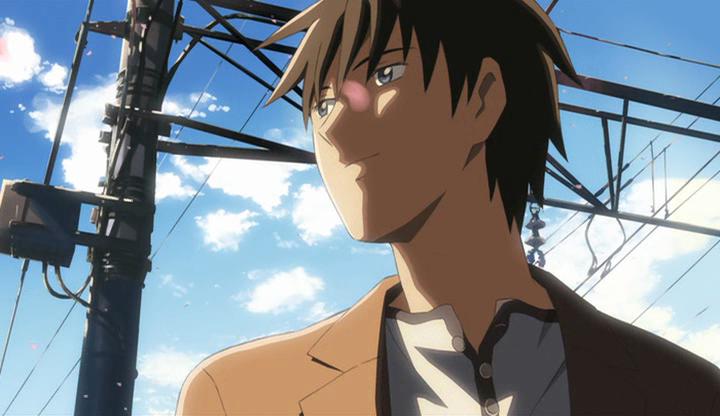
And at last, the smile. What did it mean? It’s the viewer’s guess, but I can only take it to mean that Takaki finally built up the strength he needed to move on with his life. Would he succeed? I don’t know, and I don’t think he knew, either. But as Akari’s figure disappeared behind the train, there was only one direction he could have followed from there on out. As for whether or not he would wind up happy…that’s a story for another movie day.
Ultimately, 5 Centimeters Per Second is a story about love. Whether love is good or bad, whether it’s a blessing or a curse, whether it’s the one key to happiness or humanity’s main source of sorrow…in the end, none of those things matter, because the story is about about all of them. Told subtly with minimal dialogue, beautiful visuals, and music that tugs at the heart, the film tells a tale of a young couple that didn’t get their happily-ever-after, that didn’t get their reunion under a sakura tree. And as much as I’d hate to admit it, I suppose that’s life.
Each and every one of us, I believe, has a voice at the back of our heads, wishing that a fairy tale-like love story can be possible in the real world; and yet most all of us wind up at a mental conclusion similar to the conclusion 5cm/s reached. Love is not a reunion with a childhood friend that has been in a coma for seven years, or a relationship with the reincarnation of a goddess that’s destined to die whether you like it or not; it’s something more powerful, perhaps just as passionate, but conclusively far more real. Real means that the endings aren’t always happy, that there isn’t necessarily a light at the end of the tunnel (or that the light could have been nothing more than a mirage). Real is rarely what people want to see, want to admit to, but when it forces itself upon us with the strength of a masterpiece like this, it dredges up a torrent of emotions equivalent to a million Keys.
In the end, I’m unsure of what to make of the story’s meaning. Personally, I don’t believe the plot had a central message at all; rather, it was a short but powerful story about the role love plays in our lives and about how influential it can be on the rest of our thoughts. Love is a mysterious emotion, so much so that the human race has dedicated countless works of fiction to it and yet we still can’t put our finger on what precisely it is; but it’s the occasional story like this that explores the emotion without cutting corners and pulling punches, and in doing so, it creates not only a memorable story but also an unforgettable feeling that the viewer will forever associate with that snowy train ride and the delicate falling of cherry blossoms. It is because of this thought-provoking realism that 5cm/s will remain an objective favourite of mine, but it’s thanks to this feeling that the movie’s impact will never truly leave me, regardless of how fast the cherry blossoms decide to fall.
~ ETERNAL
つづく
Post Footer automatically generated by Add Post Footer Plugin for wordpress.

Wow, this piece of writing is pleasant, my younger sister is
analyzing these things, so I am going to inform her.
Great post. more on the topic covers similar ground if you want to go deeper.
Appreciate the detail here. this guide adds useful context on the same topic. harvester-test-34916-c2c3d06f
Interesting take. a concise summary adds useful context on the same topic. harvester-test-34916-c8b28d04