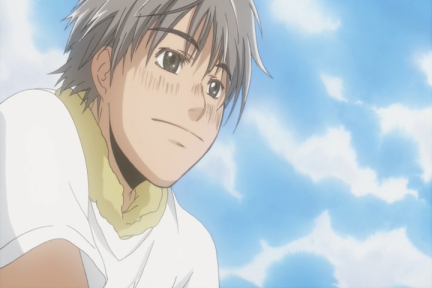
Yuuta Takemoto
As time passes, the day will come when everything will fade to memories. But, those miraculous days, when you and I, along with everyone else, searched together for just that one thing, will continue revolving forever somewhere deep in my heart as my bittersweet memory.
And finally, the main character. Takemoto, the epitome of “ordinary poor college student who has no clue as to what he wants to do after he graduates.” Takemoto, an oddly sentimental but hesitant sophomore who fell in love but didn’t do a thing about it. Takemoto, who found the will to build a massive tower, break it down, and then ride half way across Japan and back, even though he has no distinctive traits or abilities to drive him forward. Takemoto was an interesting guy because he was normal, but it was his ordinary, relatable personality that let his story culminate everything that Honey and Clover stands for.
If H&C is about love, which I firmly believe it is, then it’s only fitting that Takemoto’s arc would cover his college love from its bittersweet beginning to its bittersweet end. It began the moment he saw her; illogical, inexplicable. It took him a while to realize that it was there, but sure enough, the feeling in the pit of his stomach was not a result of spoiled milk. He tried to get closer to her, which is a natural human instinct, but he reluctantly gave up when he realized that Morita was also interested. He didn’t like when love was about winning or losing. But as time passed, he lost his direction in life, unsatisfied with his studies and unhappy with his distance from his love. And so he traveled.
The beauty of Takemoto’s arc is that it was all internal. True, he was friends with Hagu, and there were a few conversations between them that were shown, but by and large, his emotional journey took place entirely within his mind. It had nothing to do with her actions, his decisions; it was simply the result of a love that appeared where it probably should not have, running its course even though it was futile. Perhaps it is a bit like spoiled milk, when you look at it that way. Even after he was rejected, his feelings couldn’t stop; if a rejection were all it took to stop a heart from feeling, then stories like this wouldn’t exist. However, the tragedy near the end added even more to Takemoto’s stress, and when the forces of Real Life tore them apart, he was faced with a very important question: was it worth it?
And that, right there, is the single most important part of the show. It’s the central message behind every arc, accentuated through Takemoto’s solitary emotional roller-coaster. Is something that will disappear the same as something that never existed? Is a failed love a worthless love? Unlike the other characters, Takemoto hardly had any outside influences; there was no relationship, no pre-existing friendship to either create or destroy. We see his story from beginning to end, we follow his heart as he tears down his Tower of Adolescnce and journeys into the distance to determine how much he cherishes the people back home. We see him at his best and worst, and we experience his mental dilemmas as he tries to find his way through life. His story, as with the other characters’, is viewed through the lens of love, and as his love comes to an unsuccessful end, he realizes the difference between something that would eventually fade and something that never existed. He realizes something simple but fundamental about life, something that we all wordlessly come to understand as we grow older; something that cannot be fully explained in a sentence, a blog post, or even a TV show. But we can try. Chika Umino and the folks at J.C. Staff tried, and their main character tells a story of the bittersweet nature of love, and of the emotion’s strange ways of weaving its way through one’s life, leaving both scars and precious memories in its wake.

{ 19 comments… read them below or add one }
Thanks for that, I thought it was a very well written look at what is still my favourite anime series.
I love you for writing this.
And I’m going to go rewatch Honey and Clover.
But what does it mean “It’s right there in my heart?”
Does this statement establish existence vs. non-existence? What difference does that make, in the context of the narrative?
I meant it more figuratively than philosophically. You’ve seen the show, so as you know, Takemoto’s final dilemma is about whether or not his painful experiences were worth anything. That can also be applied to the other characters: did Ayumi gain anything from waiting for Mayama to return her feelings? Did Morita’s efforts pay off, even though Hagu would never be interested? And the answer, according to the show, is that there is a difference, but it’s something only you can feel. It changes something inside of you: you grow based on your experiences, and they remain in your heart as bittersweet memories, even if everything didn’t go as planned. We don’t know if Takemoto is a better person because of his unrequited love for Hagu, but we do know that he’s a different person because of it; we know that there’s a difference between something that didn’t work out and something that never happened at all.
An excellent post to start my morning.
I’ve always seen Takemoto as sort of the everyman character, which is why a lot of people are able to identify with his struggles so much. Taking a journey like what he did is something that’s looking really good right now based on where I am in life at the moment.
Stunning. Absolutely stunning, insightful, and spot on article. You nailed the central dilemmas of the main characters right on the head and really brought out why this is one of anime’s best written series ever.
This was pretty much the article I always wanted to write about the show; now I don’t need to. It’s bittersweet for me to realize that fact (just as it was for so many of the characters in H&C!), but like Takemoto I am glad to have experienced it and I am a better person for it. Bravo, bravo.
You know I don’t think I’ll ever get tired of reading Honey and Clover analysis and this is certainly one of the best I’ve read. However, what really sticks out for me is how you mentioned that Honey and Clover isn’t something that really needs critical review to be enjoyed. This is something I feel many people forget about as to what make Honey and Clover so great, the blending of an excellent narrative, comedy, etc in addition to its themes. This is also why I feel the sequel isn’t as good as the first, as there was too much focus on the themes and its introspective nature.
True; if the story were more carelessly put together, we wouldn’t be talking about it. The minute details definitely add to it and make it a masterpiece, but I don’t think it’s a necessity to look too closely. It would be interesting, but it would also add a few thousand more words :P
As for the sequel, I liked it since the themes were my favourite part of the show, but focusing on the story is a double-edged sword. For lack of a better example, you could compare it to the ending of Kannagi: most people didn’t like the plot, so the focus on the serious side of it broke the balance between comedy and story. If you liked H&C as a typical slice-of-life/comedy/romance, then yes, I can see how focusing on the themes would hurt your enjoyment, in the same way that the second half of Toradora could be seen as too melodramatic. But, like I said, the risk paid off in my experience because the introspective nature is exactly what sets it apart.
Damn. This post is like Hercules’ 12 labors, but more flowery and meaningful. Applause.
I’ll say more when I’m done reading.
Wow.
What can I say? My words fail to convey how tremendously moved I am. With absolutely no exaggeration, reading that was like the sky just opened up, the sun giving way to a brighter and more sparkling light, angels’ voices sang and heaven’s own gaze looked down upon me, and I could only stand in awe of the sheer brilliance of it all.
It’s the definitive piece on Honey and Clover, yet stands on its own quality of masterful writing and considerate craftsmanship. Bravo! T_T
Thanks for the comments, everyone. I know it sounds cliche, but I honestly think that the show itself wrote this blog post. There are times when a writer must look deeper and discuss things that are only implicit in the work of fiction, but sometimes, it all pours out naturally. This was one of those times. Honey and Clover really is a beautiful story, easily my favourite anime – favourite work of fiction, even – and I’m glad to have written something on it that has impacted even one of you.
Hi ETERNAL,
(and welcome back!)
This anime has been on my “To-Watch List” for some time; this tempting post doesn’t make it any easier! I’ve been searching it out but haven’t had any luck, but there is one place left that should have it ;-)
I began your H&C post but then realized that it might contain spoilers. Figured that I’d ask first and if so, then redouble my efforts to find it, and then read this ;-)
How safe is it to read? Since we seem to share a lot of common tastes I’m sure that the show will be thoroughly involving and enjoyable :-D
Oh, it’s definitely spoiler-ridden. A lot of what I write contains spoiler unless I say otherwise, but I guess you must have noticed that by now. Anyway, it’s a bit different from the other stuff I like (being a shoujo series and all), but it’s still romance, and it’s the exact opposite of the soap-opera styled love stories like KimiNozo and School Days. If you like romance anime outside of the general moe category, then you should definitely at least try it.
Funny you should mention… I’m in the midst of mini-marathonning it right now and *just* finished a Blog post recommending it LOL And of course I had to link to your article for those Visitors who are curious enough! Hope you don’t mind ;-)
Since I suspect that a lot of my Visitors aren’t hard-core, I steered them toward ANN’s encyclopedia entry where there’s a link to their streaming H&C eps. Since they’re only streaming 1-12 though, I kind of suggested that they might look into “other ways” to watch the rest should the become addicted. Heh.
After reading just your enticing Intro, I searched and searched and finally found the Solar subs in .avi plus the two OVAs. After just a few episodes I was hooked and realized that This Was Something Special :-D It’s really the “perfect” slice-of-life. I like very much how the focus is on those realistic movements of love, from those aching pangs of first love, to certain inevitable realizations about “the other”, to the realities of getting what you wish for and the consequences thereof. In a word, BRILLIANT.
I’m up through 16 now and expect to finish tonight. Watching as many eps as possible in a run is (for me anyway) the best possible way to keep the most intense and continual “feel” of an anime intact, rather than waiting between episodes. And “feeling” is what we’re all about, as human beings, human souls, and yes, beings with Heart…
So, once I’m finished I’ll be back to read the rest of these chapters; I’m anxious to see what you’ve written about what is sure to be a most memorable show, and what will become one of my favorites!
And then there’s the sequel…
Cheers :-)
WOW! big applause!
Completely and perfectly stunning anime ever seen!
Great review.
H&C was the most beautiful history i’ve ever seen…I think it’s because it’s so much like our lives! Masterpiece!
I get pleasure from, lead to I discovered exactly what I was looking for.
You’ve ended my 4 day long hunt! God Bless you man. Have a great
day. Bye
What i don’t realize is in fwct hhow you’re no longer really
a lot more well-appreciated than you may be ight
now. You’re so intelligent. Youu recognize thus sikgnificantly with regards to this subject,
prouced me personally consider it from so many various angles.Its like men and
women don’t seem to bee fascinated until it is one thing
to accomplish with Lady gaga! Your personal stuffgs great.
At all times deal with it up!
{ 5 trackbacks }