
As you might have noticed around the blogosphere, a few of us – prompted by Owen, of course – have decided to begin watching/rewatching Darker than Black, which aired about two years ago. The episodic/editorial crossover going on at CAT should satisfy your needs for an in-depth look at the show’s development and themes, and as the posts continue to spring up from the rest of us, I’m sure you’ll be seeing more than enough ways to look at the same thing.
Therefore, as I started to rewatch the series – quickly discovering that I forgot quite a bit of it – I realized that there was something far simpler that I could be writing about. Yes, it’s technically irrelevant, and it won’t get you any closer to understanding the symbolism and narrative techniques implemented by the director, but it’s something worth taking note of anyway.
Because, six episodes in, there’s already something quite simple that has caught my eye, and it’s making an already good story look all the more appealing. Quite simply, it’s a matter of presentation.
At the risk of sounding redundant, Darker than Black is, obviously, a dark show. It’s not the kind of thing you watch if you’re in the mood for sunny skies and J-pop; it’s meant to force you to the edge of your seat, while keeping your mind spinning the entire time. There’s certainly a story to be told, and if you hope to understand that story, you’re going to have to pay attention – no matter how gruesome or otherwise complicated things may be.
So, for a show with such emphasis on the darker side of sci-fi/psychological, why were the first two episodes actually funny?
 Business in the DtB world isn’t always as serious as it appears.
Of course, the comedy was in no way the emphasis – the point of the introductory arc was to establish a few simple facts about the series, and to give the viewer a few subtle clues on what’s to come. That said, however, I couldn’t help but be charmed by the character interactions. Stated in its simplest terms, the characters were entertaining, in the truest sense of the word, and I found myself smirking quite a few times during the episodes – made possible since I already knew how things would play out.
And yes, it’s true that the comedy fades away in the subsequent arcs, but that doesn’t take away from the fact that DtB is an extremely well-presented show – and as you know, there’s far more to presentation than comedy and entertainment.
Right off the bat, the viewer is captured by not only well-written dialogue, but a simple yet effective combination of music and visuals. It doesn’t take long at all for the series to set its tone, and in utilizing the extra focus gained from the rewatch, I was able to take note of the music, and how it works extraordinarily well with the atmosphere. Try listening closely for a moment and you’ll see what I mean: the soft yet steady percussion in the background, occasionally growing to a more furious rhythm; the rising and falling of sustained notes on the string instruments; the modern, upbeat techno and percussive effects that blend with the eerie tone of the other instruments; whatever it is that they do, they do it well, and the fact that the show draws the viewer in right away is a huge part of what makes it so appealing.
This also brings me to what should be a far more obvious point: that the separation of the story into “irrelevant” arcs is an excellent way of developing the plot and background without having to rely on forced conflicts and awkward infodumps.
Episodic anime has been done several times before – often successfully, as far as I remember, though I don’t recall seeing it in a series of this genre. However, forgetting about whether or not the idea is original, it certainly is good. The arcs, separated into two episodes each, assure that the viewer is never bored: each arc has a beginning and an end, a conflict and a solution. Each story is enough to stand on its own, and enough to entertain at face value.
Of course, the secret lies in the fact that while the viewer is engrossed in each immediate arc, other things are going on: new details are revealed about the characters of Hei and Yin, the opposing concepts of the Contractors and Dolls is highlighted, facts about Hell’s Gate and the universe within the story are revealed, and through the use of the characters introduced in each arc, we slowly step closer to the central themes of the story. All of the arcs are interconnected, in a vague, non-specific sense, and the separation of the story into arcs makes for effective exposition and guaranteed entertainment that won’t bog down the viewer with forced depth. The depth exists, certainly, but it works its way subtly into the series, and only reveals itself when it’s ready.
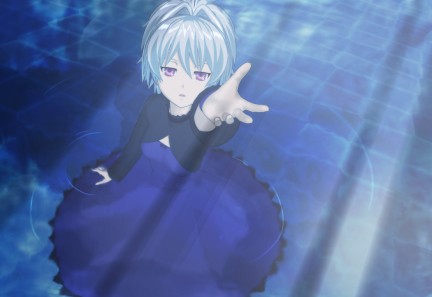
Having said all of that, I do believe that there is more to Darker than Black than meets the eye: and if you want to learn more about that, Owen and Hige have been doing a great job with the daily posts at Cruel Angel Theses. However, I think it should be said that amidst the constant search for depth and meaning, there are a few simple things that make Darker than Black a good, and digestible, show. Be it through music or directing, it’s presented in a way that holds your attention and reveals neither too much nor too little, which is integral in a series that’s all about its story.
~ ETERNAL
つづく

{ 9 comments… read them below or add one }
Ohhh, so this is why everyone’s been talking about it, huh? I was wondering why there seemed to be more than just a few people posting about it on Twitter.
Perhaps I’ll give it a watch as well and add to the party. If nothing else, the loli looks delicious :3
Nazarielles last blog post..Saki – 01
this post is kind of a long road to a very short destination – we all love tl;dr, but you need to learn to control yourself a little, lol. Anyway yes, the presentation is without a doubt by far the strongest point of DtB as I thoroughly explain in my review. Okamura really did everything he could to make it as fun to watch as possible.
digitalboys last blog post..EUPHORIC FIELD IS NOW FUZAKENNA! THIS BLOG SET TO EXPLODE IN T MINUS 10…9…
Having been one of the rare few who loved the hell out of this show back when it first aired, this is as close as I can get to paying tribute to it. Re: your point about ‘irrelevant arcs’, I found this to be a thorn in the flesh when it came to reading the opinions of those around me, since, well… I found every arc to be significant. Even those with Gai and Kiko in it.
The problem with this, of course, lies with the fact that a vast majority of viewers are impatient and want things fed to them NOW, even if it means unnatural infodumps and whatnot. A lot of us are lazy, stupid, and want to be fed pre-processed mush instead of actually chewing on our food. Hence why the bi-episodic, multi-protagonist approach isn’t really mainstream.
Then there were those who missed the understated emotional current of the whole thing and dismissed out outright as a mediocre show. Go figure.
Owen Ss last blog post..Darker than Black 05-06: “Redrum”
I got to agree with you and Owen here – presentation and the pace at which things were shown to the viewer were key to the show. Some felt the show was made up of patches of stories, and I believe one guy even believed it was shit thanks to the producer running away with the script at episode 4 (lol).
It was my favorite of 2007, so maybe I should rewatch it again. Then again, I rewatched the last few episodes back then.
Panthers last blog post..The Terror – A Year On
Definitely agree. One of the things that really struck me about DtB was the fact that I was always entertained. I’m normally pretty impatient with explanations (it’s the reason I couldn’t stand to watch more than five episodes of Higurashi), but even though I always wanted to know more with DtB, I was never unhappy with what they were giving. I also didn’t find any of the arcs to be useless — they all emphasized and highlighted different aspects of the world, and considering how much we don’t know about it, it was always great using all the new information to derive new theories, etc. That’s what made DtB engaging for me up to the end. For most other series, I would have probably dropped it by six if it continually told me so little.
Kiris last blog post..Third Look at the Art of the DOGS OAV
Nice post, and I absolutely agree. Have you seen the OVA? That seemed to disappoint some fans of the show, but it’s pretty much a single episode of condensed personality and entertainment, segregated from the network of mysteries and developments which tied the series together. It’s a favourite bit of fan service o’mine – not least because the focus is on the comedy, which always seemed the sweeter in a show with such a marked penchant for melancholy.
@ Nazarielle: Er…well, yes, I suppose she is…but don’t tell anyone I told you that!
@ digitalboy: Well, I always choose to write more rather than less since it’s the only way I can make sure to cover as many arguments as I can, but yes, it’s a technique in and of itself to say a lot using only a few words. I’ll learn it someday, trust me :P
@ Owen S: Perhaps irrelevant was the wrong word – I was getting at the fact that they’re not really connected, as opposed to being completely useless. Each story has enough momentum behind it to hold the viewer’s attention, and I don’t think any of them deserve the title of “filler,” but of course, some arcs will always be more
equalinteresting than others.@ coburn: I saw the OVA a while ago, and while I can’t remember too much from it, I do recall that it was entertaining. Side stories like that never bother me too much; if anything, they’re a pleasant change of pace from the dark tone held by nearly the entire series.
While it’s presented very well I find it’s the character development which holds the storyline together and delivers at it’s very best.
I’m intending to give it another re-watch so I can fill in the gaps where I may I have missed along the way. I’m just waiting for the entire boxset to be out locally first.
Optics last blog post..Hospitalized for the day
I watched the whole series and I can say that it’s totally worth your time. This is the kind of anime that makes you wanting to watch it all over again. There is a high re-watch factor in it and simplicity is at its best.
Sakus last blog post..Photoshoot Preview